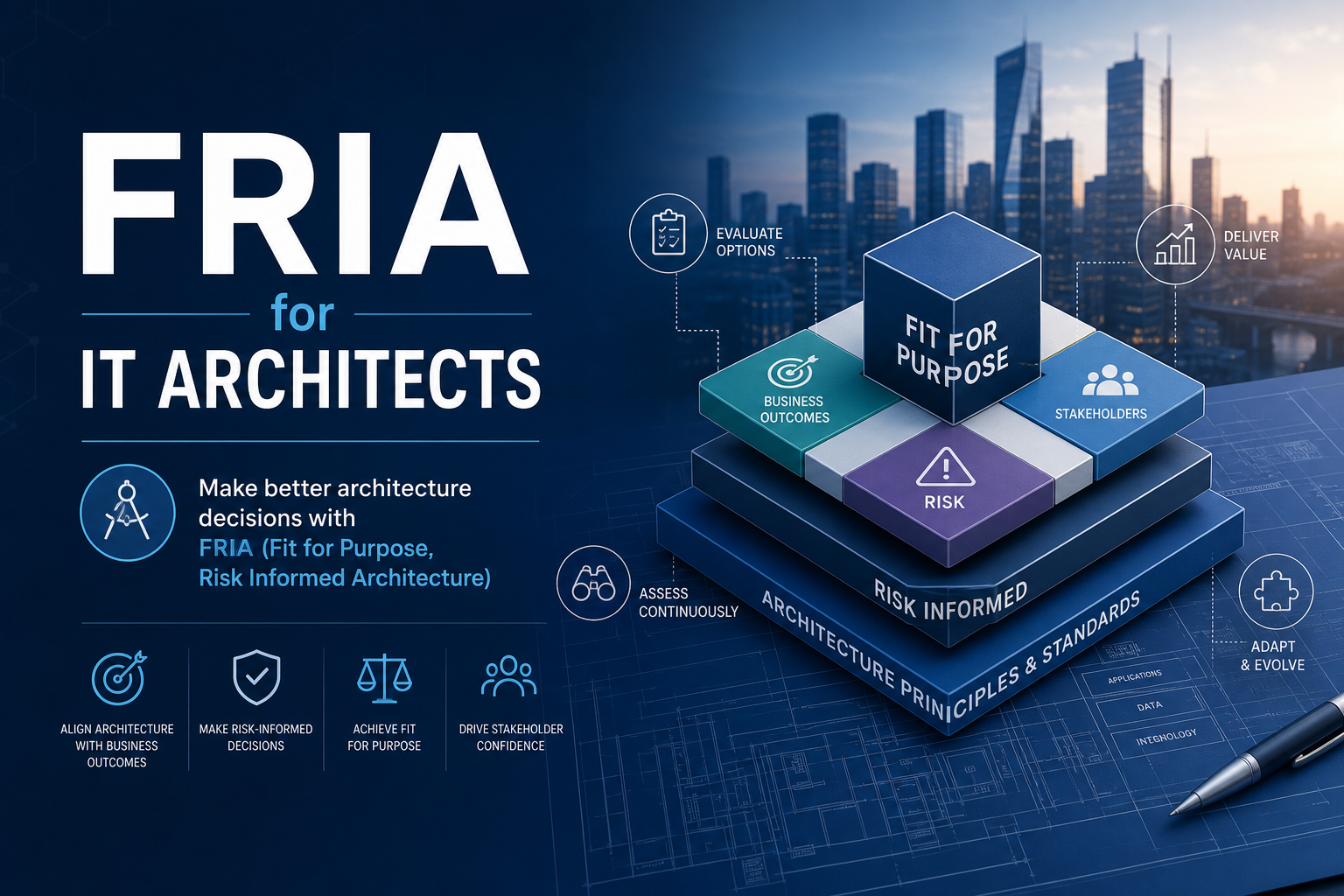
FRIA for IT Architects
Course Scenario
A managed IT service provider is designing and operating an AI-enabled case-prioritization platform for a municipal benefits agency. Throughout the course, IT architects examine how the provider and its public-sector customer can assess fundamental-rights impacts, document compliance, and monitor the solution throughout its lifecycle.
Section 1: FRIA Legal Foundations [1 hour]
-
Purpose and legal context of a Fundamental Rights Impact Assessment (FRIA), using the Dutch Data Protection Authority’s practical FRIA guidance as a reference point.
-
Conditions that trigger Article 27 of the EU AI Act, including high-risk AI classification, covered deployers, first use, and changes requiring an updated assessment. (eur-lex.europa.eu)
-
Roles of the AI provider, deployer, IT service provider, subcontractor, and customer, with emphasis on how architecture decisions and contracts affect responsibility.
-
Fundamental rights relevant to the recurring platform, including privacy, data protection, nondiscrimination, access to public services, effective remedy, and human dignity.
Section 2: Designing for FRIA Compliance [2 hours]
-
Defining the system’s intended purpose, operational processes, architecture boundaries, deployment period, usage frequency, integrations, and foreseeable misuse.
-
Identifying affected individuals and groups, including vulnerable populations, indirectly affected people, and groups that may experience unequal outcomes.
-
Connecting system components, data flows, model outputs, and human decisions to specific risks of harm to fundamental rights.
-
Selecting safeguards such as data-quality controls, access restrictions, explainability information, human review, override authority, fallback procedures, and service-continuity measures.
-
Establishing governance responsibilities, approval authorities, complaint and redress mechanisms, escalation paths, and coordination between the service provider and customer.
-
Structuring the compliance evidence package, including FRIA records, architectural decisions, provider documentation, control ownership, notification information, and alignment with a GDPR Data Protection Impact Assessment. (eur-lex.europa.eu)
Section 3: Compliance Monitoring Systems [1 hour]
-
Monitoring architecture for system performance, data drift, outcome disparities, human overrides, complaints, access events, control failures, and service incidents.
-
Traceability design using inventories, version records, audit trails, decision logs, risk-control mappings, and evidence-retention rules.
-
Compliance-management workflows that connect architecture repositories, service management, risk registers, model governance, incident management, and reporting dashboards.
-
Lifecycle triggers for reassessment, including changes to purpose, models, data sources, affected groups, usage patterns, vendors, integrations, or identified risks.
Web Sources
Section 4: Final Review
-
Review of FRIA applicability, responsible actors, required assessment content, architectural safeguards, governance evidence, and continuous compliance monitoring.
-
Future learning directions: detailed high-risk AI classification, sector-specific fundamental-rights analysis, emerging FRIA templates and regulatory guidance, AI assurance standards, and advanced compliance-architecture patterns.
The History of Data
FREE Intro | ~2 hours
From punched cards to Lakehouses and AI-ready data platforms: understand the evolution of data and why the future is starting now.
What you'll gain (free entry point):
- ✅ Key milestones in data technology (1940–2025)
- ✅ Why relational databases, Hadoop, cloud, and lakehouses emerged
- ✅ The shift from batch → real-time → AI-driven data
- ✅ Lessons from the past you can apply today
- ✅ Context for modern architectures (Lakehouse, Semantic, etc.)
Ideal as a first step for anyone serious about data engineering or architecture.
Outline (~2 hours total):
- The early days: punched cards & mainframes
- The relational revolution & SQL
- Big Data & the Hadoop era
- Cloud, data lakes & warehouses
- The rise of Lakehouse, AI & semantic data
- Summary & what it means for you
Start completely free – no credit card, no catch. Discover the history behind your future work.
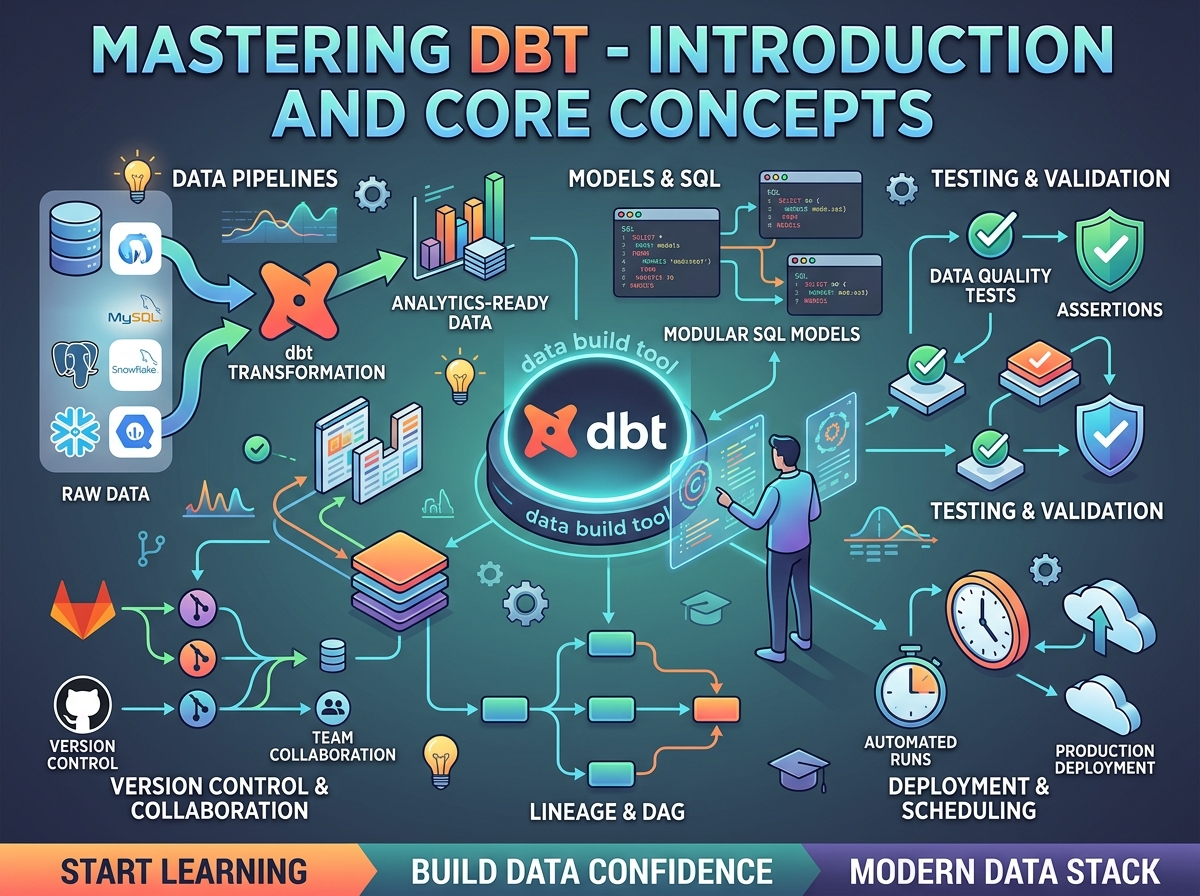
Course on Mastering dbt - introduction and core concepts
Section 1: Introduction to dbt [1 hour]
-
What is dbt: Overview of dbt and its role in modern data transformation workflows.
-
Importance in E-Commerce: How dbt can optimize data-driven decision-making in e-commerce sectors.
-
Key Features: Understand dbt's fundamental features, including modular SQL development, testing, and documentation.
-
Visualizing Data Lineage: Explore dbt's ability to map the entire data lifecycle from raw data to analytics.
Section 2: ELT vs. ETL [1 hour]
-
ETL Overview: Brief overview of the traditional Extract, Transform, Load process.
-
ELT Explained: Understanding Extract, Load, Transform and its advantages in cloud environments.
-
Transition to ELT: Why more businesses, particularly in e-commerce, choose ELT over ETL.
-
Case Study Comparison: A look at how ELT with tools like dbt optimizes performance.
Section 3: dbt and Medallion Architecture [1 hour]
-
Medallion Architecture Explained: Overview and how it structures data flow.
-
Role of dbt: Examine dbt's integration and contribution to the medallion architecture.
-
Benefits in E-Commerce: How using dbt within this architecture improves data quality and accessibility.
-
Real-life Applications: Analysis of e-commerce scenarios utilizing dbt and medallion architecture.
Section 4: Installation and Setup Guide [1 hour]
-
Prerequisites Check: Reviewing basic SQL, git, and Python skills necessary to proceed.
-
Tool Setup: Choosing between dbt Cloud and Core with pros/cons.
-
Docker Installation: Step-by-step guide to install a Postgres Docker container for the Jaffle Shop sample project.
-
Profile and Project Configurations: Configuring
profile.ymlanddbt_project.ymlfor successful dbt project setup.
Section 5: Final Review
-
Review of Key Concepts: Summarize dbt's role, ELT vs. ETL, and medallion architecture insights.
-
Future Learning Directions: Suggestions for advancing into advanced dbt functionalities and data engineering skills.
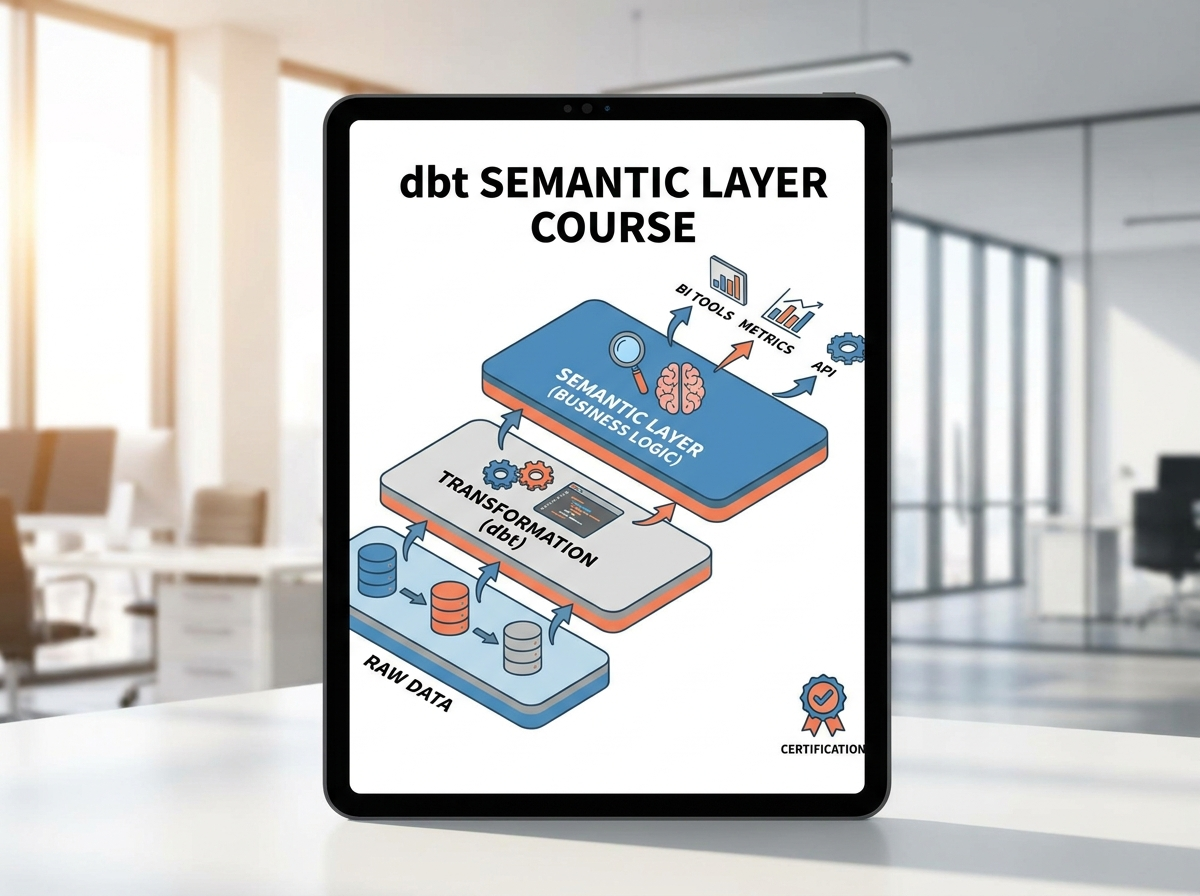
Unlock the Power of Consistent, Actionable Insights with dbt Semantic Layer Master dbt’s Semantic Layer Using a Practical School Database Example
Are you a data engineer, analyst, or BI professional tired of inconsistent metrics, duplicated logic across tools, and endless back-and-forth with stakeholders?
Discover how the dbt Semantic Layer revolutionizes data engineering by centralizing your business logic, ensuring every team works from the same source of truth. This hands-on course uses a relatable school database scenario — perfect for educators, EdTech professionals, or anyone wanting an intuitive, real-world context to learn advanced concepts.
Why Enroll in This Course?
- Build Trustworthy Data Products: Learn to define entities, metrics, and dimensions once in dbt — and reuse them everywhere with perfect consistency.
- Hands-on & Immediately Applicable: Work directly with DuckDB and integrate seamlessly with Google Looker for stunning visualizations.
- Practical School-Focused Examples: From student enrollments and attendance rates to exam performance metrics — see exactly how semantic layers drive educational insights.
- Efficient & Modern Workflow: Move beyond fragmented queries to governed, self-serve analytics that scale.
Course Structure (5 Hours Total)
Section 1: An Introduction to Semantics in Data Engineering (1 hour) Understand what a semantic layer is, why it matters, its evolution in the industry, and how it delivers consistency, accessibility, and faster insights — using school data as the perfect illustration.
Section 2: Setting up the dbt Semantic Layer for a School Database (1 hour) Get started with dbt fundamentals, configure the semantic layer with DuckDB, connect to Google Looker, and troubleshoot common setup challenges.
Section 3: Diving into Entities and Metrics in a School Context (1 hour) Define and manage entities (students, classes, courses) and build powerful metrics (graduation rates, average scores, retention) tailored to educational environments.
Section 4: Querying School Data with the dbt Semantic Layer (1 hour) Master querying via dbt CLI and Google Looker. Compare approaches, apply best practices, and extract meaningful insights from your school dataset.
Section 5: Final Review and Path Forward in Data Engineering Consolidate your learning, review integrations and querying techniques, and get clear next steps for advancing your skills in educational (or any domain) data engineering.
Who Is This Course For?
- Data engineers and analysts implementing or expanding dbt projects
- BI developers and dashboard creators seeking metric governance
- Educators, EdTech data teams, or professionals who want practical, relatable examples
- Anyone ready to move from raw data pipelines to governed, business-ready analytics
By the end of this course, you’ll confidently design, implement, and query a production-grade semantic layer — turning complex school (or business) data into reliable, reusable insights that drive real decisions.